


Previous campaign
Operation Steadfast Resolve (2014)
Takistan
Campaign order
Campaign order
Operation Steadfast Resolve (2014)
With the Iron Curtain falling, the power vacuum has created incentive for other nations to take up the mantle of military and economical superpowers. As such, it came no surprise that a resource rich nation of Takistan would force themselves onto the global stage.
Situation
The long lasting, yet uneasy alliance between the Takistani Caliphate has lasted throughout the entirety of the Cold War. Maintaining neutrality in the face of NATO and the Warsaw Pact, the Caliphate has held the position of a powerhouse in the Middle East, and having them as the “top dog” meant that both the East and West had to worry about only 1 potential enemy or ally in the long run. After decades of annexation and invasion of neighboring countries, they have fortified themselves as the leading country in the region in every regard. With the economy blossoming, political unrest being at an all time low, it seems as if the Caliph Abu Bakr has done the impossible and united what was once a volatile and unstable region where dozens of great empires have met their untimely demise.
As the USSR, and alongside it, the entire Warsaw Pact has collapsed, we no longer have to worry about uneasy alliances as now we have no rivals with financing and supplying the Caliphate for them to see us as allies and long term benefactors.

ABOVE: The US delegation after negotiating an arms deal, supplying the Takistani Caliphate with small arms, armored vehicles and helicopters, 1969.
EQUIPMENT
- Radios: personal radio systems, short range widespread, long range for SL+
- CTAB/Blue Force Tracking: CTAB for SL+ via GD300
- Navigation: GD300 for SL+ only
- Maps are not synchronized
- Optics: Assorted standard issue red dot, holographic, LPVO and ACOG sight.
However, our concerns are mounting that the Caliphate may be looking to transition from a regional powerhouse into a global superpower. Alongside the long lasting reign of 53 years under the Caliph Abu Bakr and the oil based economy, the recent economic reforms and rare-earth mineral discoveries have increased the buying power of the Caliphate to the 6th global economy. That in itself would not be an issue if the most recent military unveiling did not have us like a cat on a hot tin roof. The arsenal of US and Soviet weapons and gear they have stockpiled has not only undergone modernization and extensive upgrades, it has also been supplemented by something we hoped never to see again.

ABOVE: Takistani National Army Special Forces marching alongside the Soviet made TELs (Transporter Erector Launchers) outfitted with what we suspect to be domestically produced SCUD missiles, most likely reverse engineered R-17/R-300 missiles.
The missiles pose not only a great concern, but also a great threat to the immediate region and outside region as well. With a suspected range of over 700 km, we are worried that the Caliphate may have big plans in the future, looking to extend their sphere of influence outside of the region and become a player at the global scales of power and dominance. Being a non-signatory to both the United Nations Security Council Resolution 1540 and the Chemical Weapons Convention, which we assumed was due to their inability to manufacture WMDs, this has been a startling discovery. To make matters worse, a company that we believe is a front and a proxy for the Caliphate has been suspected of trafficking chemical agents and weapons into the region.
With certain regions undergoing undisclosed bouts of sickness among the local populace, it is believed that improper storage or handling of chemicals used in WMD production may be the cause. With IDAP (International Development & Aid Project) being in the region to monitor, assist and deal with the issues caused by the sickness, we have the perfect cover for maintaining a covert presence in the area before we stage an invasion of the region to bring an end to the WMD situation.
TERRAIN

ABOVE: Map of Takistan’s southwestern governorate, Al-Rayak.
The region of Al-Rayak is a coastline region characteristic of its hill ranges being divided by rivers and valleys featuring savannas and steppes across its sprawling territory. As such, it is guarded by varied branches of the Takistani Armed Forces, such as the Ground Forces bolstering their vast motorized and mechanized brigades, the Navy with their Litoral Defense Guard and the National Air Force with their wide array of Western, Eastern and domestically produced fixed wing and rotary wing assets.

ABOVE: UAV footage showing the varied terrain and flora of Al-Rayak
FRIENDLY FORCES (BLUFOR):
Assisting UNITAF with intel acquisition, data processing and covert observation is the Central Intelligence Agency, using their vast network of informants, field agents and operatives embedded in the local populace and institutions.
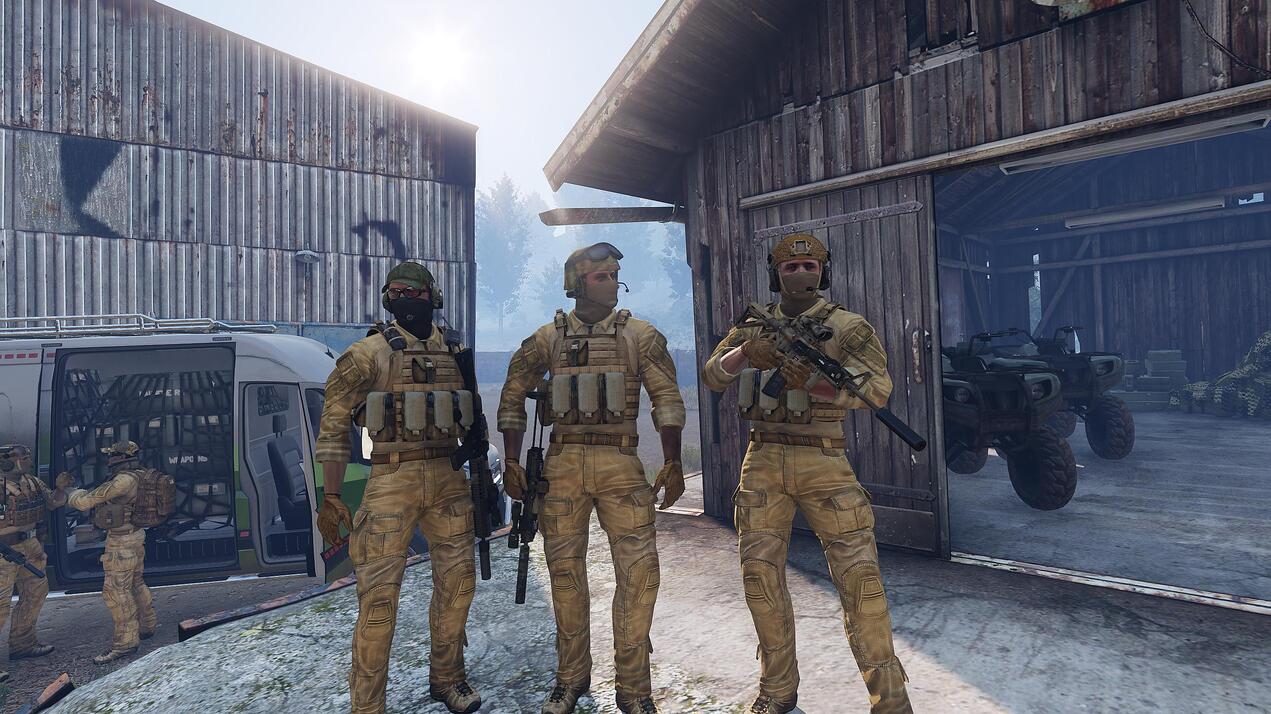
ABOVE: CIA Field Operatives branding mission specific gear and equipment.
For the heavy lifting and heavy hitting, we have the United States Marine Corps assigned to the Amphibious Ready Group as a part of the Marine Expeditionary Unit.

ABOVE: United States Marines with standard issue gear consisting of the FROG MARPAT-D uniforms, SPC body armor and MICH 2000 or LWH head protective gear.
Aiding the USMC with direct attack capabilities, unconventional warfare, special operations and various other missions, is the Marine Raider Regiment

ABOVE: Marine Raider CSOs (Critical Skill Operators) from the 1st Marine Raider Battalion
OPPOSITION FORCES (OPFOR):
The main task of the Takistani National Army is to protect the independence, sovereignty, territorial integrity and social organization of the Takistani Caliphate and its citizens.

ABOVE: The most recent military parade by the Takistani Armed Forces, showcasing their wide array of modernized Cold War vehicles and domestically produced variants of current generation vehicles.
Tasked with safeguarding the airspace above Takistan and maintaining total aerial superiority, the Takistani National Air Force makes use of aerial superiority fighter employment, anti-air defenses and their radar early warning systems, as well as using close air support fighter-bomber aircraft and multi-mission rotary wing aircraft alongside airborne insertable infantry unit to provide means of quick response and swift military action in anypart of the region.

ABOVE: Assorted Western and Eastern produced rotary wing aircraft, outfitted with a wide array of mission specific equipment. From left to right: CH-146 Griffon with AT capabilities due to TOW launchers, UH-1 Bell with FFAR dumb-fire rockets serving as a QRF gunship, Mi-24 Hind outfitted for multimission capabilities including AA and CAS engagements, and Mil-8 equipped with ground assault and CAS equipment, used to prepare the ground for infantry insertions.
BELOW: Both imported and domestically produced versions of aerial superiority fighters and fighter bombers. From right to left: Domestically produced version of the Mig-29 SM outfitted with CAP specific equipment, Yugoslav imported Mig-21 bis equipped with CAP specific equipment, SU-25 with CAS and ground assault armament, including cluster munitions, and domestically produced Aero L-39 CAS fighter-bomber equipped with ground assault armament.

Designed around rapid response doctrine and coastline patrol and protection, the Littoral Guard is tasked with defense readiness, maritime law enforcement, Ports, waterways and coastal security (PWCS) and does so by employing QRF teams through the use of air and sea assets.

ABOVE: Rigid Hull Inflatable Boat used to patrol, interdict and engage vessels in the littoral coastline of Al-Rayak.
BELOW: CH-146 Griffon with communication, surveillance and radar systems used to patrol and assist the RHIB QRF teams.

Seen as the army outside of the army, the Takistani Ministry of Internal Affairs is divided into several bodies consisting of the regular police officers, SWAT QRF teams for any more severe problems or when it comes to doing shady business on behalf of the Caliphate, utilization of the Central Information Bureau teams, who are trained alongside and recruited from the military.

ABOVE: The Takistani Police Bureau alongside the various vehicles in use by the Ministry, mainly donated from both the West and the East
BELOW: SWAT team with the rapid response vehicles most often employed by them to quickly respond to any violent clashes


ABOVE: The famed Central Intelligence Bureau of the Takistani Ministry of Internal Affairs, seen here performing live fire exercises in a mock compound. Note the proper positioning, use of cover and overall combat readiness of the unit.