Emergency braking communication
If the lead vehicle must brake suddenly, the driver must announce “BRAKING, BRAKING, BRAKING” over comms to prevent collisions.



The FM outlines our core skills, policies and guides to ensure every member stands ready for the mission ahead.
FM/G299 · Convoy
If the lead vehicle must brake suddenly, the driver must announce “BRAKING, BRAKING, BRAKING” over comms to prevent collisions.
Gunners must maintain 360° security at all times. The lead vehicle is responsible for observing to the front, the rear vehicle covers the rear, and interior vehicles alternate left and right to ensure continuous coverage in all directions. Gunners should cover their assigned sectors and resist the urge to fixate on one threat direction.
Vehicles must maintain a spacing of 20 to 100 meters, adjusted for terrain and visibility. This interval must be preserved while moving, turning, or stopping to reduce vulnerability to explosives and concentrated enemy fire.
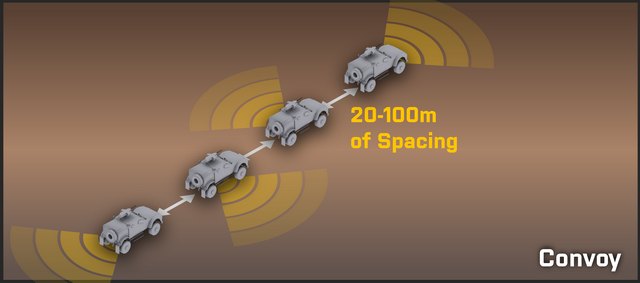
Maintain the correct position in a convoy as set by the element leader
Each convoy operates on a dedicated radio frequency to coordinate all vehicles. This frequency is separate from infantry or other command nets and is either pre-planned during the mission brief or selected at convoy formation. The convoy net is non-transactional: communications are broadcast to all vehicles without requiring individual acknowledgment.
The convoy net is used to coordinate movement and maintain situational awareness among vehicle crews, support elements, and mounted infantry.
Transmit the appropriate calls on the convoy net during movement:
First and Last Vehicle:
Any Vehicle in Convoy:
On 13 role cards in 2 combat areas.
By combat area
 Cavalry
Every role
 Rolecard Development
1 of 11
Next in Convoy
FM/G302 Convoy halts and security procedures