UNITAF Future
UNITAF

Caution

This site is a work in progress

This site is finished to different degrees. Feedback is welcome. Please bear in mind that most of what you see, if not everything, is still a work in progress.

Data from the live site is synced here every hour. Anything you do on this site stays here. It is not copied back to the live site until we switch over.

Discord and permissions are linked. Be careful with admin actions. Some of them also change Discord.

UNITAF members taking orders before an operation
Force Manual

The FM outlines our core skills, policies and guides to ensure every member stands ready for the mission ahead.

FM/G335 · Explosives

Engineering equipment

Passages
5
Reading time
3 mins
Views
50
Owned by
Unit Command
Platforms
Every platform
Published
23 Sep 2026
On this page

Engineering equipment planning

Engineering roles require deliberate equipment selection based on mission tasking. Unlike fixed combat loadouts, engineering equipment can be tailored to the objectives outlined in the OPORD. Likely tasks may include mobility (breaching, clearance), counter-mobility (mines), or explosive disposal (EOD).

If specific equipment is not prescribed, you and your element leader are responsible for selecting the tools required to accomplish the assigned tasks. Base your decisions on mission phase, likelihood of use, and available transport.

Prioritize equipment as follows:

  • Mission-critical items required to complete assigned objectives.
  • Secondary items supporting likely follow-on tasks.

Avoid overloading with low-probability tools.

If required equipment exceeds your carrying capacity, inform your element before removing any Core Combat Load (CCL) FM/BP-387 items. Engineering supplies may be redistributed within the element or transported via vehicle support.

Firing devices / detonators

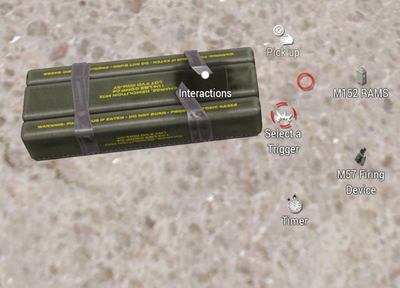
Detonators are used to initiate explosive charges on command. Depending on configuration, a detonator may trigger individual charges or simultaneously detonate all linked explosives.

Available detonator types may vary by mod, Era's and technological capability FM/BP-386, or conflict setting, and may include functional limitations based on range or terrain.

Common detonators used in UNITAF include:

  • M57 Firing Device: 250 m effective range; signal affected by terrain.
  • M152 Firing Device: 5000 m effective range; signal affected by terrain.
Selection of a Detonator when arming an explosive charge

Defusal equipment

Defusal equipment is required to safely disarm explosives and mines. The defuse interaction will not be available unless the appropriate equipment is equipped.

Engineering personnel must ensure required defusal tools are carried when explosive hazard tasks are anticipated.

Default defusal Kit
Default defusal Kit

Mine detectors and mine sweepers

Mine detectors and sweepers are used to locate armed explosives prior to clearance or defusal. Different device types exist depending on the Era's and technological capability FM/BP-386 setting of the mission.

Two common categories are:

Manual Sweepers (e.g., VMH3, VMM3)
These devices are equipped in the secondary weapon slot and must be actively used to detect explosives. They emit an audible tone when an armed explosive is within approximately 5 meters. The tone changes as the sensor head moves closer to the device, allowing the user to refine the location and identify the explosive’s position in three dimensions.

Mine Detector Panels (e.g., handheld detectors, vehicle or drone-mounted systems)
Typically present in more modern or future settings, these systems provide a visual detection interface in addition to an audible cue. Armed explosives are highlighted on a small radar-style display when within detection range.

If using a detector panel system, remove any equipped helmet camera prior to operation, as it will disable the regular detector panel's operation.

Marking danger areas

When encountering explosive hazards, clear and consistent marking is essential to protect follow-on elements. Engineers are responsible for communicating both danger areas and verified safe paths.

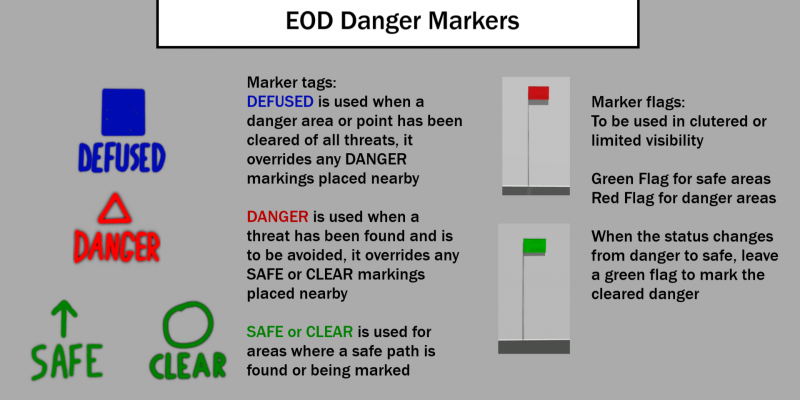
Two primary marking tools are available: EOD stencils and flag markers.

EOD Stencils
Stencils use text and standardized shapes for rapid recognition. Three color-coded statuses apply:

  • DEFUSED: Indicates the area or device has been cleared of all threats. Overrides any nearby DANGER markings.
  • DANGER: Indicates a confirmed threat. Overrides any SAFE or CLEAR markings in the vicinity.
  • SAFE / CLEAR: Indicates a verified safe path or cleared area.

Markings should be placed clearly and unambiguously to prevent conflicting signals.

Flag Markers
When ground tags are not visible (e.g., tall grass, debris, uneven terrain), use flag markers instead:

  • Red flags: Mark confirmed danger areas.
  • Green flags: Mark safe lanes or cleared areas.

If a danger area marked by a red flag is later cleared, replace or supplement it with a green flag to ensure clarity for follow-on elements.

Placement Standard
Markers must be visible from a distance. Safe lanes should be marked at regular intervals, with each marker visible from the next to create a continuous path. Danger markers should be positioned at eye level when ground visibility is limited to ensure they are not overlooked.

Markings available with the EOD Stencil

Next in Explosives

FM/G156 Identifying and reacting to explosive devices