


UNITAF Future
UNITAF

Caution

This site is a work in progress

This site is finished to different degrees. Feedback is welcome. Please bear in mind that most of what you see, if not everything, is still a work in progress.

Data from the live site is synced here every hour. Anything you do on this site stays here. It is not copied back to the live site until we switch over.

Discord and permissions are linked. Be careful with admin actions. Some of them also change Discord.

UNITAF members taking orders before an operation
Force Manual

The FM outlines our core skills, policies and guides to ensure every member stands ready for the mission ahead.

FM/G91 · Casualty management

Casualty collection points (CCP)

Passages
7
Reading time
2 mins
Views
69
Owned by
Unit Command
Platforms
Every platform
Role cards
10 cards
Published
23 Sep 2026
On this page

Introduction to CCPs

A Casualty Collection Point (CCP) serves as a centralised and secure location for the treatment of casualties. The primary aim is to coordinate care efficiently, making use of all available resources to ensure that casualties are ready to return to action as quickly as possible. This involves crucial processes such as triage, coordination, and prioritisation, with the goal of enabling a unit to move without delays caused by waiting for individuals to recover. 

Situations that might require immediate attention include scenarios where:

  • medics are incapacitated
  • leadership is compromised
  • the CCP location lacks sufficient security
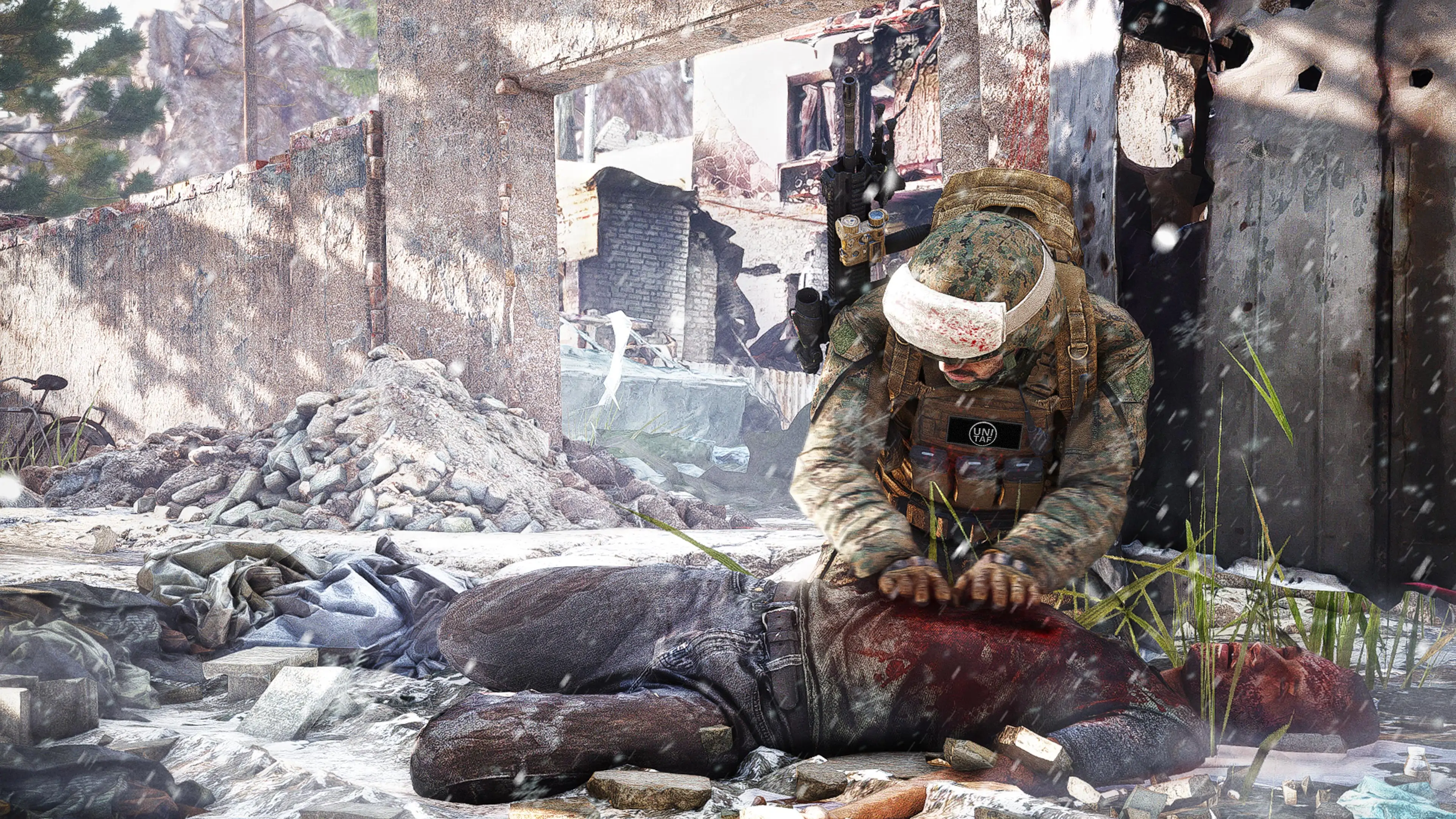
Types of CCPs

CCPs are categorised into two types: improvised and planned. While the preference is always for a CCP to be planned, circumstances may necessitate the use of an improvised CCP, especially if a unit is rendered combat ineffective or unable to reach a pre-established CCP. Improvised CCPs are set up in defensible locations close to the site of the incident, focusing on the stabilisation of casualties and organised based on the available space to separate different triage states.

Choose a location for a CCP

Choose a location with the best combination of the following factors:

  • distance to casualties to be brought over
  • protected from enemy fire
  • enough room to walk around
  • easily accessible, especially for people carrying patients
  • no internal choke points

Setting up an improvised CCP

An improvised CCP is a contingency measure, utilised when it's impractical to transport casualties to a planned CCP. It's established by the most senior medic present, prioritising the collection and stabilisation of casualties away from direct conflict. The selection of a defensible location near the incident site is crucial, with organisation tailored to the specific environment to effectively manage different triage categories.

Setting up a planned CCP

A planned CCP is ideally situated behind the frontlines, balancing accessibility for casualty evacuation with safety from immediate dangers such as indirect fire (IDF). These CCPs are equipped with advanced medical supplies and are set up in anticipation of need, especially when a Medical Emergency Response Team (MERT) or Combat Medical Team (CMT) is involved. Coordination and supply logistics are managed to ensure readiness for treating a high volume of severe injuries, under the guidance of a designated senior medic who oversees the optimisation of resources rather than directly administering treatment.

Follow the medical chain of command

As a medic working at a mass casualty incident (MCI) or casualty collection point (CCP):

  •  follow this hierarchy:
    • MERT Officer or CMT Leader
    • Platoon Medic
    • SF Medic
    • MERT or CMT Technician
    • Squad Medic
    • Combat Medic
    • Combat Life Saver
  • execute the tasks given by those above in the hierarchy
  • give tasks to those below in the hierarchy

Communicate with leadership

Communicate the following information to your leadership at regular intervals:

  • Casualty count, by triage
  • Estimated time to recovery
  • A need for more help, if required

On role cards