Sight Usage
The term "sight picture" refers to the way the front sight, crosshair, or reflex dot is oriented relative to the target being engaged. The typical sight picture you want to achieve is that of the center-of-mass hold, which is where the sight rests on the upper chest of the enemy, or the center of their visible mass. This is intended to give you the best possible chance of hitting them. If they are further away than you thought, and your bullet drops more than you were expecting, the shot should still land on their body. The same can be said for people who are closer than you realized.
With a good center-of-mass hold, you can expect to reliably hit standing targets out to 300-400 meters. The smaller the target, the more likely that you'll be forced to use the 'offset aiming' technique to score hits. This is simply the process of aiming over your target if you're shooting low, or to the side if the round is landing beside them. Offset aiming is generally required with fixed red dot optics, such as the ACO or Holosight. With ironsights, the sight distance can be adjusted. Pick a range that fits where you expect combat to most likely occur, and make this your "battlesight zero". If you begin engaging targets at longer ranges and need more precision, adjust the sights accordingly.
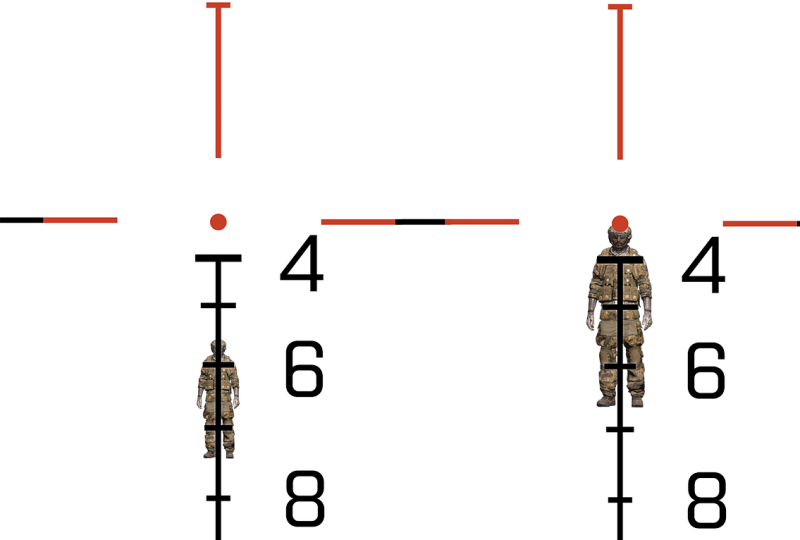
When working with magnified optics, many will have what is known as a Ballistic Drop Compensator ("BDC"). This is a feature of the reticle that has horizontal hashmarks descending down the central sight line - often with numbers beside them. These numbers correspond to ranges in hundreds of meters. To hit a target at a given range, simply align them with the corresponding hashmark. Most BDCs have horizontal marks that correspond to the width of a human's torso, shoulder-to-shoulder, at the given range - this helps for estimating ranges. In the below illustration, the left sight is aligned with a 600 meter target, while the right one is aligned at 400 meters.