Horizontal Coriolis force: introduction
On its path around the Sun, our planet rotates on its axis at a staggeringly fast constant speed - and all things in contact with the planet spin along with it. A vehicle in motion, a cyclist at rest, even a rooted tree all spin along with the planet as they are in direct contact with the Earth. When an object separates from the planet, such as a ball being tossed into the air, this inherited rotational velocity gradually begins to decrease as the object in flight meets air resistance while no longer being propelled by contact with the spinning Earth. As observed from our constantly rotating rifles, this gradual loss of rotational velocity shows itself when a bullet in flight begins to rotate around the earth slower than our scopes and appear to drift to the left or right on its way to the target. We call this relative motion the Coriolis effect.
Variables
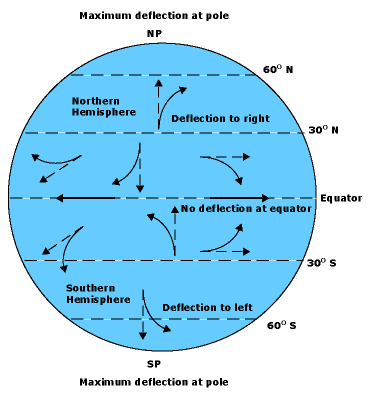
Both the direction and the magnitude of horizontal Coriolis deflection will change according to global position. As we move closer to either the North or South pole (as latitude increases), horizontal Coriolis deflection will also increase, with the most extreme effect being observed directly on either geographic pole. As we move away from the poles and towards the equator (as latitude decreases), horizontal deflection also decreases, with horizontal Coriolis deflection being entirely absent directly over the equator. Direction of deflection is dependent on which hemisphere a projectile is in, deflecting to right in the northern hemisphere and to the left in the southern.
Relevance
The Coriolis effect produces a relatively small effect on our bullets’ trajectory when compared to primary variables such as bullet drop and wind, or even secondary variables like spin drift. In the opening applications of marksmanship where speed is key, Coriolis deflection is well accounted for by a fast and measured follow up shot in response to any misses. In more advanced applications of marksmanship, where precision becomes precedent and greater ranges more common, Coriolis will become a relevant variable to factor into a firing solution - the effect producing tangible point of impact shifts between 800 and 1000m.