Spotting bullet impacts
The ability to spot a bullet’s impact is incredibly important in long range shooting. While a hit on target may be fairly obvious, spotting a miss and correctly providing a correction can be even more important. This can sometimes be difficult for the shooter who has to recover from recoil or whose optics may not be powerful enough to see the impacts at range. This is where the spotter comes in.
Positioning
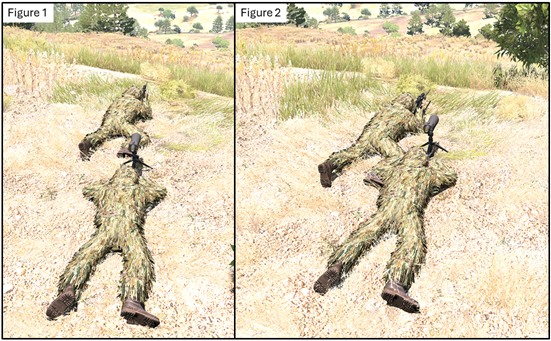
In order to best observe bullet impact and provide the most accurate corrections, the spotter’s sight picture needs to be as close as possible to the shooter’s. That means looking at the target from nearly the same bore height (level of the gun barrel) and with as little offset left or right as possible. To accomplish this, the spotter should place themselves either directly behind the shooter or immediately next to them and behind the shoulder on the same side as the weapon. Adjustments for terrain or other obstructions should be kept to a minimum if possible. Figures 1 & 2 below illustrate the proper positioning as close as possible given limitations of object placement in the game.
This way the shooter will see and measure a missed shot the same as the shooter would through his scope. For example: if a shot missed by 2 mils right from the shooter’s perspective, a spotter positioned several meters or more to the shooter’s right might only observe an error of 1 mil and would not provide an accurate correction as a result.
Spotting impacts
Bullet impacts can be readily observed at moderate distances with regular rifle optics, depending on terrain. At longer ranges the spotting scope will help the spotter see impacts that the shooter cannot. To have the best chances of observing bullet impacts at long range, the scope must be set to maximum zoom in. Also, it is helpful to set terrain detail in the game options to the highest setting your system can handle.
Bullet trace
When terrain does not allow for spotting of bullet impacts, or when shooting past a target that does not have a solid backdrop, the spotter can observe bullet trace to see where the shot went. Trace is the blurring effect in the air along the path of the bullet as it travels at supersonic speeds, pushing the air aside and causing distortion.
The spotter needs to be directly behind the shooter or as close as possible to observe this effect. Because trace appears along the arc of the bullet’s flight path, the spotting scope should be zoomed all the way out so as not to lose sight of the trail as the bullet changes elevation. Also, bullets do not leave trace at subsonic speeds so this will not be a useful technique past around 1200m depending upon the cartridge being used.