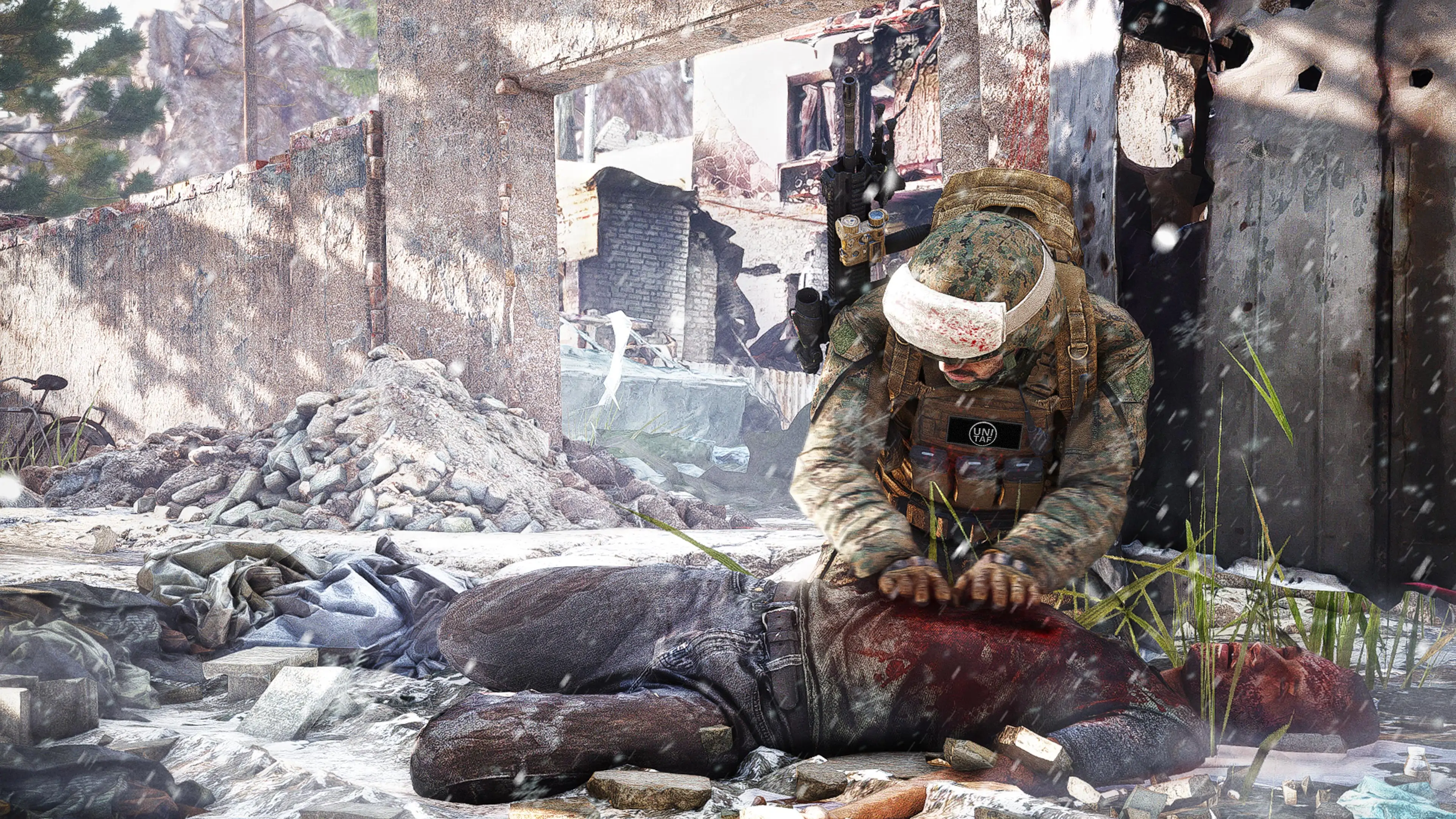
The FM outlines our core skills, policies and guides to ensure every member stands ready for the mission ahead.
FM/BG-182 · v1.02
Working with mass casualty incidents (MCI)
- Code
- FM/BG-182
- Kind
- Guide
- Version
- v1.02 2yrs ago
- Views
- 554
- Platforms
- As its document
- Published by
- SP3 Jochem 28 Dec 2023
- Last material change
- v2.00
18 words added, 0 words removed.
v1.01
Teamwork and communication between medical personnel is vital to ensure all the patients are getting the care they need. When only dealing with only one or a few casualties teamwork can simply be done by stating what you are doing with the patients e.g. “I am giving patient name morphine” so actions on a singular patient don't happen more than they should. In any case the most senior medic should always ensure that all patients are receiving care.
For MCIs a more structured approach is needed. For example the most senior medic can task a CLS with:
tourniqueting all limbs, checking airways, bandaging head and torso, stitching or CPR.
A Squad medic may be tasked with ensuring airways are clear and all casualties are receiving blood.
A Platoon medic may be tasked with triaging incoming wounded and tasking other helpers to ensure all casualties are being treated.
When a CCP is being run by a medical team or setup by a medical team these roles should be assigned prior to casualties arriving for efficient treatment, for example:
A medical team may have a setup similar to this:MTO: Triaging and tasking medic personnel, communicating with leadership, medication, help out wherever needed.MTA: Casualty collection , stabilise patients, stitching head and torso, CPR.
MT 1: Giving blood, stitching head and torso, CPR, mangaging heart rate.
MT 2: Airway management, mangaging heart rate.
MT 3: Medication, stabilising patient, mangaging heart rate, stitching.
v1.02
Communication moves to casualty management
This turns into a guide on how to assign tasks at a CCP
Teamwork and communication between medical personnel is vital to ensure all the patients are getting the care they need. When only dealing with only one or a few casualties teamwork can simply be done by stating what you are doing with the patients e.g. “I am giving patient name morphine” so actions on a singular patient don't happen more than they should. In any case the most senior medic should always ensure that all patients are receiving care.
For MCIs a more structured approach is needed. For example the most senior medic can task a CLS with:
tourniqueting all limbs, checking airways, bandaging head and torso, stitching or CPR.
A Squad medic may be tasked with ensuring airways are clear and all casualties are receiving blood.
A Platoon medic may be tasked with triaging incoming wounded and tasking other helpers to ensure all casualties are being treated.
When a CCP is being run by a medical team or setup by a medical team these roles should be assigned prior to casualties arriving for efficient treatment, for example:
A medical team may have a setup similar to this:MTO: Triaging and tasking medic personnel, communicating with leadership, medication, help out wherever needed.MTA: Casualty collection , stabilise patients, stitching head and torso, CPR.
MT 1: Giving blood, stitching head and torso, CPR, mangaging heart rate.
MT 2: Airway management, mangaging heart rate.
MT 3: Medication, stabilising patient, mangaging heart rate, stitching.
Where it appears
Lives in
FM/G41 Mass casualty incidents (MCI)On role cards
On 10 role cards in 1 combat area.
By combat area