Milliradians: Mil-dot reticles
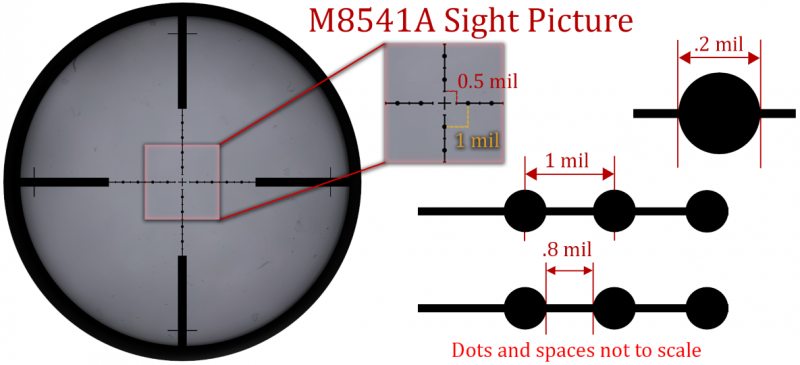
In your typical mil-dot scope you will find a reticle with markings of dots or lines and these markings follow one prime rule: their centres are spaced 1 mrad apart.
For all properly modelled mil-dot reticles, the rule is further:
- from centre to centre of adjacent dots, there is 1 mrad,
- from edge to the close edge of an adjacent dot, there are 0.8 mrad,
- a mildot is 0.2 mrad wide.
They can also have other properties that extend their utility. Some have additional markings in between the main ones. Some have stadiametric tools to quickly get a range from a known object, or a combination of all of these features.
A commonly issued scope is the M8541A as illustrated, so it serves to manage expectations throughout. In its case, the dots are 1 mrad apart with 0.5 mrad dashes in between, making for accurate at-a-glance measurements.
First focal plane vs. second focal plane
Telescopic sights come in two ‘zoom flavours’:
- FFP or first focal plane, scopes show a constant sub-tension of markings. This means that the markings mean the same at any given zoom level, but it shrinks with lower magnifications and grows with larger magnifications. Their advantage is therefore that you can use the mil-relation formula as-is, without an intermediate conversion for the zoom factor. Their potential disadvantage is that lower magnifications make the reticle harder to read, which could hinder follow-up adjustments in close-quarters situations. FFP scopes are the most commonly issued scopes.
- SFP or second focal plane, scopes come with reticles that stay a constant size at every zoom level. This means that their angular measurements are only true at one specific power setting: usually the highest. If the space between two markings is 1 mrad at 12x magnification, it would cover 2 mrad at 6x magnification instead. This can be useful for shooters who expect proportionally many close-range engagements, where fully zooming in with a high-power scope narrows the field of view too much, causing tunnel vision and loss of awareness. In such close-range situations, the scope can comfortably be kept at the lowest power setting but maintain a clear and visible reticle. Their disadvantage is that for accurate distance measurements at any magnification other than the true magnification, you have to convert. Good practice is to keep it at the 1:1 setting when ‘milling’ a range to avoid this.